



Strong, Safe, and Built to Last: Features of a Premium Power Cord
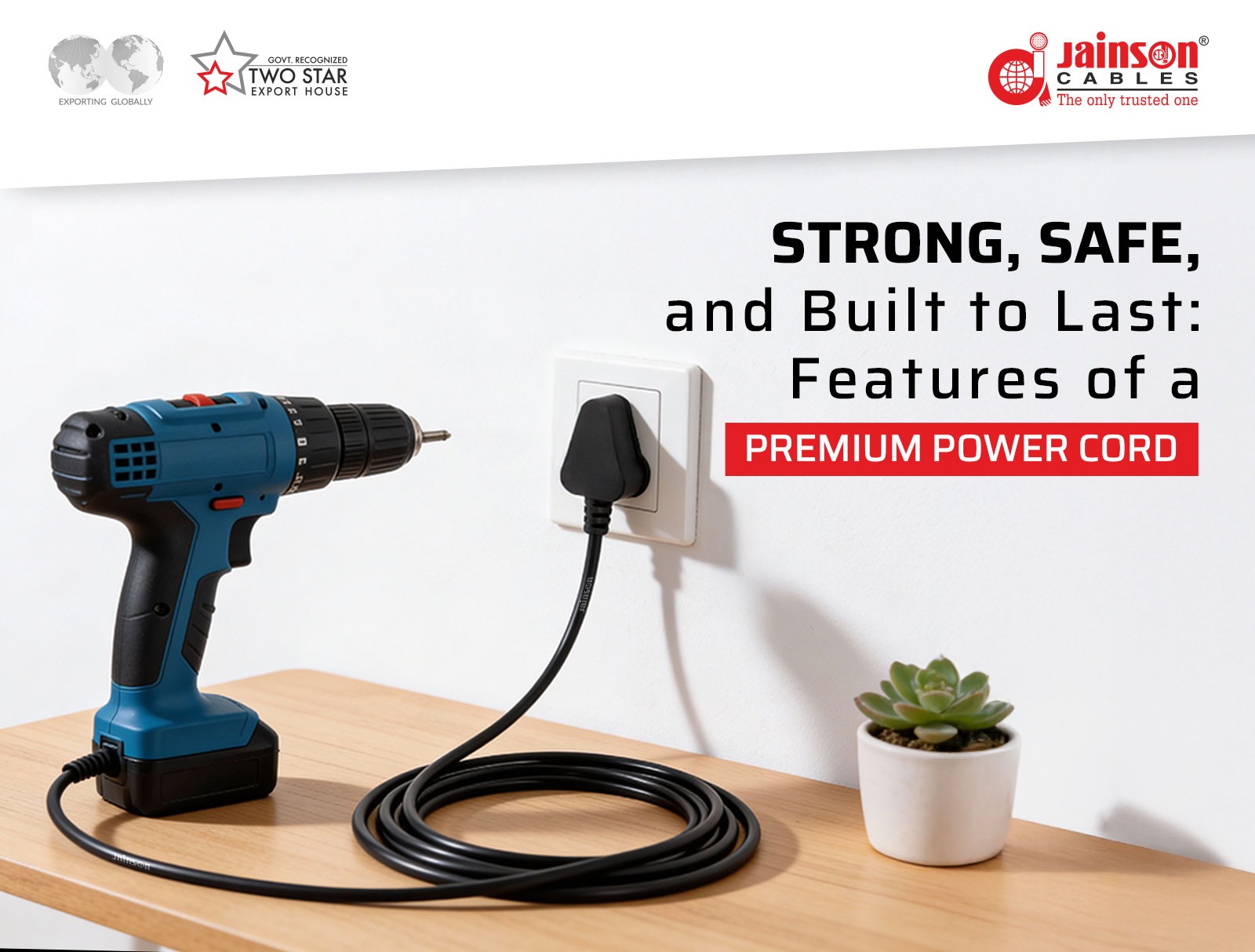
A premium power cord is a purpose-built electrical component engineered to deliver controlled power transfer, withstand mechanical stress, and maintain thermal stability under continuous load. Its performance depends on the quality of materials, the precision of manufacturing, and the integrity of its electrical and mechanical design. Understanding these factors is essential when selecting a high-quality power cord ensures durability, operational stability, and consistent safety.
This blog breaks down the core technical attributes that define a premium power cord and how Jainson Cables incorporates engineering precision into every product.
1. Engineered Copper Conductors: The Foundation of Performance
The conductor is the most critical element in a power cord. Premium-quality cords use copper that is processed, drawn, and stranded under strict tolerances.
Key conductor characteristics include:
-
Purity of Copper: Electrolytic Copper (EC) ensures high conductivity and minimal resistance to the flow of current.
-
Uniform circular mil area (CMA): Ensures consistent resistance and prevents localized hot spots.
-
Fine-stranded structure: Enhances flexibility and reduces mechanical stress during bending or coiling.
-
Controlled oxide levels: Maintain conductivity over long operational cycles.
This uniformity ensures predictable electrical behavior, reduced voltage drop, and stable current delivery.
2. Insulation Architecture Designed for Dielectric Reliability
Power cord insulation is a multi-layer system engineered to maintain dielectric strength, structural integrity, and thermal stability.
Premium insulation design features:
-
Concentric dielectric layers maintain a uniform electric field distribution.
-
Soft and Flexible Insulation allows high flexibility and low bending radius.
-
Heat-stabilized polymer blends that resist deformation during sustained load temperatures.
-
Low-permittivity materials that limit capacitive coupling in long cords.
-
Moisture-resistant insulation compounds capable of maintaining insulation resistance in humid environments.
These characteristics prevent breakdown, surface tracking, and premature insulation fatigue.
3. High-Performance Outer Jacket for Environmental and Mechanical Protection
The outer jacket determines how well a power cord withstands real-world handling and exposure.
A premium jacket provides:
-
High tear resistance to prevent sheath breach when dragged or compressed.
-
Calibrated softness for additional flexibility and cut resistance.
-
Oil-resistant formulations suitable for industrial machinery and workshop settings.
This ensures long-term structural integrity even under repeated bending, impact, and surface abrasion.
4. Mechanical Fatigue Resistance Validated Through High-Cycle Testing
Mechanical degradation is a major cause of cord failure. Premium cords undergo performance testing beyond basic compliance.
Typical fatigue tests include:
-
High-cycle flex testing that simulates continuous movement.
-
Torsion testing for equipment with rotational motion.
-
Strain-relief assessment at plug and device entry points to prevent stress concentration.
These tests confirm that the cord can maintain conductor integrity and insulation stability through repeated mechanical stress.
5. Precision Termination for Low-Resistance and Long-Term Stability
Termination quality directly influences safety, temperature rise, and operational reliability.
Premium cord terminations feature:
-
High-pressure crimping for minimal contact resistance and zero micro-arcing.
-
Corrosion-resistant terminal alloys for stable conductivity in varying environments.
-
Vibration-resistant mechanical locking for appliances with motors or compressors.
-
Optimized the connector geometry that distributes current uniformly.
Accurate termination ensures consistent performance throughout the cord’s lifetime.
6. Integrated Safety Features That Define a Safe Electrical Cable
Safety in a power cord is the result of engineered design features—not just compliant materials.
Key safety elements include:
-
Flame-retardant jacket compounds are designed for controlled flame propagation.
-
High dielectric withstand performance validated through elevated-voltage tests.
-
Leakage current suppression through optimized insulation geometry and material purity.
-
Internal fault containment that limits arc formation under overload or failure conditions.
These integrated safety elements allow the cord to perform reliably under demanding electrical conditions.
7. Application-Specific Engineering for Reliable Operation
Different applications impose distinct mechanical and thermal stresses. Jainson Cables engineers power cords tailored for precise use-cases such as:
-
High-temperature appliances (heating equipment, ovens, HVAC systems)
-
Industrial machinery exposed to oils, vibrations, or abrasive surfaces
-
Outdoor equipment that requires UV stability and moisture resistance
-
Precision electronics where low leakage and dielectric stability are essential
Each category uses custom insulation formulations and jacket blends aligned with the operational environment.
8. How Jainson Cables Ensures Consistent Reliability
Jainson Cables incorporates manufacturing controls and material engineering to deliver measurable and repeatable quality.
Their approach includes:
-
Strict copper sourcing and draw control to maintain conductor uniformity.
-
Precision extrusion for concentric insulation layers with consistent dielectric thickness.
-
Automated defect detection using Spark Testing and optical inspection.
-
Material formulations engineered for application-specific performance, such as heat resistance, oil resistance, or flex durability.
-
Routine batch testing covering tensile strength, insulation resistance, and high-voltage endurance.
Each of these processes contributes to power cords that perform reliably under continuous load and mechanical stress.
9. Selecting a High-Quality Power Cord: What to Evaluate
Technical evaluation ensures the cord aligns with the intended application.
Key checkpoints include:
-
Conductor purity and stranding design
-
Dielectric strength and insulation material
-
Jacket formulation matched to the environment
-
Termination integrity and contact stability
-
Mechanical endurance under flex, torsion, and strain
-
Compliance with relevant electrical and safety standards
Choosing based on technical specifications—not general labels—ensures long-term safety and performance.
Conclusion
A premium power cord is defined by engineered conductor uniformity, dielectric reliability, mechanical resilience, and precision termination. These attributes determine how consistently and safely a cord performs over its operational life.
Jainson Cables applies application-specific engineering to every power cord, using copper drawn to controlled resistivity targets, insulation compounds formulated for defined dielectric strength, and jackets calibrated for abrasion, oil, or temperature exposure depending on the end-use. Each production run undergoes measurable quality checks, including concentricity scanning, elongation testing, and high-voltage impulse testing, to ensure the cord performs consistently under electrical and mechanical stress.
With this precision-built approach, Jainson supplies power cords suited for high-load appliances, impact-prone industrial tools, and continuous-duty equipment where conductor stability and insulation integrity are critical. This technical alignment among material selection, manufacturing accuracy, and field requirements enables Jainson Cables’ power cords to deliver predictable performance, extended service life, and reliable safety margins in real operating conditions.